
Armoured Vehicles Explained: The Science Behind Modern Ballistic Mobility and Protection
Modern security threats continue evolving across military, law enforcement, diplomatic, and civilian environments. From armed attacks and ambushes to IED threats, civil unrest, and high-risk transport operations, organisations increasingly require vehicles capable of protecting personnel while maintaining mobility and operational effectiveness.
Armoured vehicles have become critical assets for military forces, government agencies, private security teams, diplomatic protection units, and critical infrastructure operators worldwide. Today’s systems combine advanced ballistic protection, blast resistance, mobility engineering, and integrated technology into highly specialised platforms designed for survival in hostile environments.
Modern armoured vehicles are no longer simply reinforced trucks or SUVs. They are carefully engineered systems designed to balance protection, performance, reliability, and operational capability.
In this article, we explore the science behind armoured vehicles, ballistic and blast protection technologies, vehicle armouring processes, and why modern protected mobility platforms play such an important role in today’s security landscape.
What Is an Armoured Vehicle?
An armoured vehicle is a vehicle specifically engineered or modified to protect occupants against threats such as:
- Small arms fire
- Ballistic attacks
- Blast and IED threats
- Fragmentation
- Forced-entry attacks
- Civil unrest
- Ambush scenarios
Armoured vehicles may include:
- Tactical military vehicles
- Armoured SUVs
- Armoured personnel carriers (APCs)
- VIP protection vehicles
- Cash-in-transit vehicles
- Border patrol vehicles
- Special operations platforms
The primary objective is to maintain mobility and survivability during hostile incidents.
The Evolution of Armoured Vehicles
The concept of protected mobility has existed for centuries, but modern armoured vehicles evolved rapidly during the 20th century through military conflict and technological advancement.
Early systems focused primarily on:
- Steel armour plating
- Basic ballistic resistance
- Battlefield troop transport
Modern armoured vehicles now incorporate:
- Advanced composite armour
- Blast-resistant engineering
- Lightweight ballistic materials
- Electronic systems integration
- Run-flat mobility systems
- Situational awareness technologies

Today’s vehicles are highly sophisticated survivability platforms.
Ballistic Protection in Armoured Vehicles
Ballistic protection is one of the most important aspects of armoured vehicle design.
Vehicle armour systems are engineered to defeat threats such as:
- Handgun rounds
- Rifle fire
- Armour-piercing ammunition
- Fragmentation
Protection levels are commonly tested to internationally recognised standards such as:
- EN1063
- VPAM
- NIJ standards
- STANAG 4569
These standards help define resistance against specific ballistic threats.
How Ballistic Vehicle Armour Works
Vehicle armour works by absorbing, deforming, or dispersing the energy from incoming projectiles.
Modern armour systems may use combinations of:
- Ballistic steel
- Composite armour
- Ceramic materials
- Aramid fibres
- Bullet-resistant glass
The goal is to stop penetration while minimising secondary fragmentation inside the cabin.
Transparent Armour and Ballistic Glass
One of the most technically challenging aspects of armoured vehicles is transparent armour.
Ballistic glass systems are typically made from multiple layers of:
- Glass
- Polycarbonate
- Laminated polymers
These layers work together to:
- Absorb impact energy
- Prevent penetration
- Reduce spall and fragmentation
Modern ballistic glass can stop high-powered rifle threats while maintaining optical clarity.
However, transparent armour remains significantly heavier than standard automotive glass.
Blast Protection and Mine Resistance
Modern conflicts have increased the importance of blast protection.
Blast-resistant vehicles are designed to protect occupants from:
- IEDs
- Landmines
- Underbody explosions
- Fragmentation blasts
Engineering features may include:
- Reinforced floors
- V-shaped hull designs
- Energy-absorbing seating
- Blast-resistant structures
The goal is to redirect blast energy away from occupants and maintain survivability.
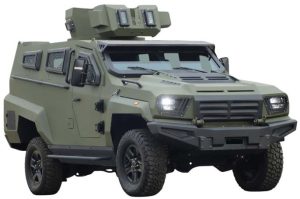
The Science Behind V-Hull Design
Many military vehicles use V-shaped hulls to improve mine and blast resistance.
The angled hull helps:
- Deflect blast waves outward
- Reduce upward force transfer
- Minimise structural damage
This design became increasingly common during conflicts involving widespread IED threats.
Vehicle Armouring Process
Civilian and tactical vehicles can be armoured through extensive modification processes.
This may involve:
- Replacing body panels with ballistic materials
- Installing ballistic glass
- Reinforcing suspension systems
- Upgrading brakes
- Strengthening door hinges
- Adding run-flat tyre systems
The challenge is maintaining vehicle performance despite increased weight.
Run-Flat Tyre Technology
Run-flat systems allow vehicles to continue moving after tyre damage.
These systems are critical during:
- Ambush situations
- Escape manoeuvres
- Hostile environments
Run-flat inserts help maintain mobility even after puncture or ballistic impact.
Mobility is often considered just as important as armour itself.
Weight vs Mobility
One of the biggest engineering challenges in armoured vehicle design is balancing:
- Protection
- Mobility
- Payload capacity
- Fuel efficiency
Heavier armour improves protection but may reduce:
- Speed
- Acceleration
- Off-road capability
- Reliability
Modern armoured vehicle engineering focuses heavily on lightweight protection solutions to improve mobility.
Armoured Vehicles in Different Operational Environments
Military Operations
Military armoured vehicles are used for:
- Troop transport
- Reconnaissance
- Convoy protection
- Urban warfare
- Border security
Modern military vehicles increasingly prioritise modular armour and survivability systems.
Diplomatic and Executive Protection
VIP and diplomatic vehicles are designed to protect occupants during:
- High-risk travel
- Civil unrest
- Assassination attempts
- Kidnap threats
Discreet appearance is often important for these platforms.
Many armoured SUVs are intentionally designed to resemble standard civilian vehicles.
Law Enforcement
Police tactical units use armoured vehicles during:
- Active threat incidents
- Counter-terrorism operations
- High-risk warrants
- Riot response
Protected mobility improves both officer safety and operational capability.
Critical Infrastructure and Oil & Gas
High-risk industrial environments increasingly use armoured vehicles for:
- Personnel movement
- Site security
- Remote operations
- Border region travel
This is especially relevant in regions facing instability or elevated security risks.
Electronic Systems and Situational Awareness
Modern armoured vehicles increasingly integrate advanced technology including:
- 360-degree camera systems
- Drone integration
- Secure communications
- Thermal imaging
- GPS tracking
- Counter-drone systems
Situational awareness has become a major focus in modern vehicle survivability.
Armoured Vehicle Standards and Certification
Professional armoured vehicles are tested to internationally recognised standards.
These tests evaluate:
- Ballistic resistance
- Blast survivability
- Glass integrity
- Structural performance
Certification helps ensure vehicles perform as intended under real-world threat conditions.
The Rise of Civilian Armoured Vehicles
Demand for civilian armoured vehicles has grown significantly due to:
- Increased global instability
- Executive protection requirements
- High-net-worth security concerns
- Humanitarian operations
- Conflict-zone logistics
Modern civilian armoured vehicles now range from luxury SUVs to discreet executive sedans.
The Future of Armoured Vehicles
Armoured vehicle technology continues evolving rapidly.
Emerging developments include:
- Lightweight composite armour
- Electric armoured vehicles
- Autonomous protection systems
- AI-assisted threat detection
- Hybrid propulsion systems
- Integrated counter-drone capability
- Enhanced blast mitigation materials
Future vehicles will likely become increasingly connected, intelligent, and adaptive.
Why Armoured Mobility Matters
Protection alone is not enough.
Modern security operations require vehicles capable of:
- Maintaining mobility under attack
- Protecting occupants
- Supporting communications
- Adapting to diverse environments
Armoured vehicles provide a critical balance between survivability and operational capability.
This is why they remain essential across military, diplomatic, industrial, and security sectors worldwide.
Final Thoughts
Modern armoured vehicles represent a highly advanced combination of ballistic science, blast engineering, automotive performance, and operational technology.
From military troop carriers and tactical response vehicles to discreet executive SUVs and critical infrastructure transport platforms, today’s armoured systems are engineered to provide protection, mobility, and survivability in high-risk environments.
As global security challenges continue evolving, armoured vehicles will remain a critical component of modern operational planning and personnel protection strategies.
Advances in lightweight armour, blast mitigation, smart systems, and integrated situational awareness technologies will continue shaping the future of protected mobility for years to come.